From Mendoza we flew directly to Buenos Aries. Instead of staying at a
traditional hotel, we decided to use airbnb, which is an alternative service where travelers rent out a room or apartment from a local
resident at a competitive price. For this leg of the trip, we rented a studio apartment in the quaint yet urban neighborhood of Recoleta.
The tree lined streets were full of boutique shops, cafes, and residents walking their designer dogs.
What
surprised us the most about Buenos Aries was the resemblance to large Spanish cities. Many
of the buildings were designed in an European style and the majority of the people looked Spanish. We learned that after Spain invaded
Argentina, the Europeans decimated the native
population so thoroughly that they never really mixed much.
We explored the city primarily on foot, heading first to Evita's grave
site. Buenos Aries has several art galleries and we wished we could have
visited more than we did. On a few occasions, we showed up at galleries that were closed. Our favorite exhibit we did see was Art of Contradictions. Pop, Realisms and Politics. Brazil – Argentina 1960 at Fundación PROA. The exhibit contrasted the differences between popular art in socialist-leaning countries versus its counterpart in capitalist countries. A few of the pieces really got us thinking.
Paying our respects to Evita
Coca-Cola vs. Che Guevara.
"A guerrilla fighter does not die to be hung on a wall."
"Order and Progress"
Claudia Andujar
Of course we had to experience Argentinean tango while in Buenos Aires. Tango got its start largely in the immigrant community in the lower income area of La Boca. It was later taken to Paris, where it evolved into a more sophisticated dance before it became popular again in Argentina. Although La Boca is still mostly lower income, its two block historic center has become a huge tourist hot spot
featuring street performers, cafes, restaurants, and
souvenir shops. It was fun to watch the street performers but the vibe was pretty artificial. La Boca reminded us of
Fisherman's Wharf and Pier 39 back home: a historic area that played a major role but over the years became a tourist trap devoid of local residents.
Today, most porteños (i.e. Buenos Aires residents) dance at Milongas, which is what they call the tango clubs. Since we did not have any tango background, we took an hour long
introductory tango lesson with a mixed group of travelers from throughout
South America. The package included dinner and a show. Although
the performance was geared towards tourists, it was still very authentic. The dancers where extremely talented and the performance was well
choreographed, in contrast to the street dancers we later saw in La Boca. The performance was purely tango, which is what we wanted.
Tango on the streets of La Boca.
Our first tango class.
Professional tango performance
We used the remainder of our time to wander the streets and eat at cafes and small local restaurants. There were not too many famous sights too see, which was fine with us because that left us more time to eat.
El Cuarito's famous pizza.
Street hot dogs with a choice of dozens of toppings.
Traditional mate
On our last morning we took a four hour bike tour. We learned
that biking has become a important aspect of city planning and a lot of bike lanes have been
added in the past three years. Even coming from one of the top American cities for biking, we were very jealous of Buenos Aries' expansive network of protected
bike lanes. Even so, our bicycle guides wished there were even more bike lanes. We biked to multiple spots in Buenos Aires, where the
guides pointed out important buildings and
explained the historical changes the city has undergone. Our
guides also shared their perspectives on government politics and their country's future. We recommend anyone who knows how to ride a bike to take a similar tour.
City bike tour.
Loving the protected bike lanes.
We departed Buenos Aries by bus from the main terminal. Its long corridor contained several restaurants, cafes, stores and even a barber. The bus terminal quality surpassed those of some small international airports.
After exerting ourselves to the limit in Northern Patagonia, we were in need for some R&R -- rest and relaxation. We departed Bariloche in the afternoon bound for the Mendoza region, the epicenter of Malbec wine.
The most direct (not fastest) way to get to Mendoza was an overnight bus ride. Argentina's buses are nothing like the common Greyhound bus in the States. The Argentine buses were luxurious in comparison, with multiple classes from which to choose. A game of Bingo, hot meals, movies, and a fully reclinable seat made the northbound trip enjoyable. We departed at 3PM and arrived in Mendoza at 8:30 well rested and ready to experience what Agrentina's wine country had to offer.
Departing Bariloche
Getting ready for bed.
We stayed at a guesthouse named Posada Olivar in the quaint town of Chacras de Coria, which lies outside the city of Mendoza. Our room opened out to an olive grove in a beautiful and peaceful private property. We rented bikes from the property owner and set out to the nearby small wineries, or bodegas.
At the first bodega, we had a tour and wine tasting followed by a delicious lunch accompanied with their signature Malbec. The fermentation facilities were originally built circa 1950 and have been beautifully preserved. We took our time enjoying the ambiance before giddily mounting our bikes to head to the next winery. We made sure to better watch our wine intake at the next place.
Perfection in the making
Antique cellar
Embracing the local culture.
Bike vineyard tour.
We had heard that Argentinians eat late but we had not expected how late. By the recommendation of our pasada owner, we decided to eat dinner at a local favorite spot. We arrived close to 9PM for dinner, late by American standards. By the time we left at 10:45PM the restaurant was packed and had a line outside the door with children as young as five waiting to eat dinner!
Impatiently waiting for the 9PM dinner
Steak cooked to perfection
Pear + Malbec = Delicious Dessert
The following day we walked around the town square to enjoy a local crafts and antiques sale. We people watched and wandered around the small town before lounging back at the beautiful posada. We had a lazy day, which was exactly what we needed to recharge for the rest of our vacation.
Breakfast at the posada
Local wine crafts at the town square market
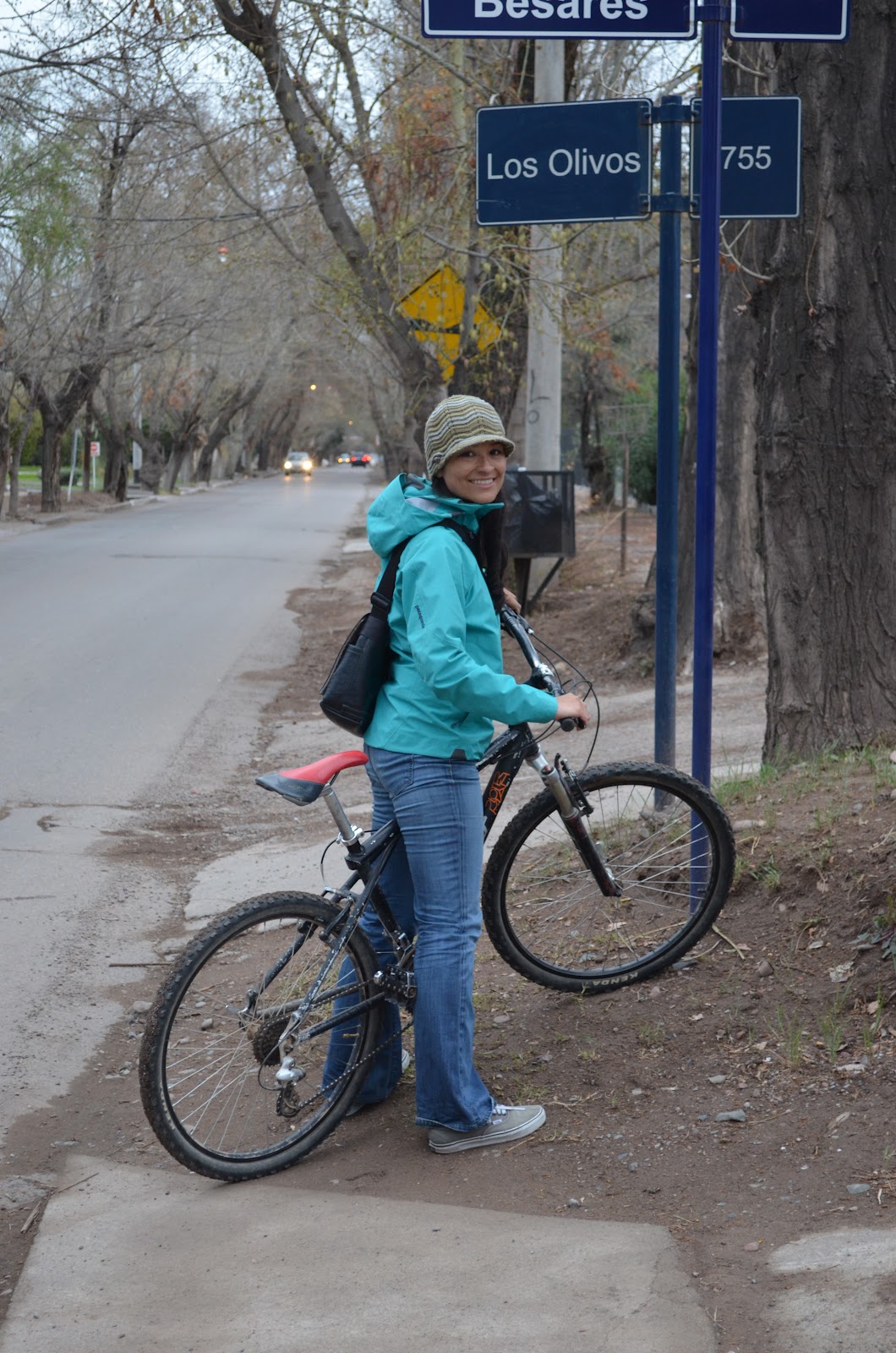
Second day here and they are already naming streets after Laure
To celebrate Quarup's 30th birthday, we took a trip down to Argentina and started our adventure in Bariloche, located in Northern Patagonia.
Northern Patagonia's Andes mountains.
In the 1930's, Bariloche modeled its city center after Swiss alpine villages and earned themselves the name "Little Switzerland". As the city became more popular, its commerce sprawled beyond the original alpine building style to cater to incoming throngs of tourists, thus losing much of its original charm. That being said, we still found many chocolate shops and a good fondue restaurant.
Tiramisu chocolate.
But let's face the truth, we came to Argentina wanting to try their famous beef steak. Shortly after settling into our hotel we were on the hunt for meat. Our expectations were definitely met at dinner with a huge slice of bife de chorizo. Laure set aside her vegetarian preferences so she could fully experience Argentinean culture.
Bife de chorizo is an Argentinian signature steak.
On our first full day, we checked out the nearby ski resort Cerro Catedral. Sadly, the mountain did not receive much snow this season. On the bright side, this was Laure's first time snowboarding since her surgery last year and she was excited to be back on the slopes. The view from the mountain was breathtaking. The large alpine lake Nahuel Huapi is visible from the towering mountains that surround it. The mountains themselves seem to go on forever into the heart of Patagonia.
Laure in front of Nahuel Huapi Lake.
Quarup and the Andes.
On the following day, we set out on our four day backcountry snowboarding trip with our mountaineering guide, Federico Arletti. Federico grew up playing in the Northern Patagonian mountains and became in charge of the avalanche advisory for some of the surrounding area.
We jump-started our journey by taking two ski lifts from the base of Cerro Catedral ski resort, which felt very strange with our huge backpacks. We then made our way out of the resort, across the ridge over to the adjacent valley, which was a little scary with the strong winds and the lose rocks. We descended with our snowboards and big backpacks one person at a time in order to minimize avalanche danger.
Crossing the ridge to the valley.
Crossing streams with big backpacks sucks.
We skinned our way up to the hut named Refugio Frey, where we would be staying for the next three nights. The hut is part of a network of alpine huts created by Clube Andino Bariloche, an organization similar to the Sierra Club in the United States. The hut is removed from modern amenities and service roads. It has a humble restroom without flushing toilets or showers. On a more positive note, the hut has a keeper that cooks very good food and maintains the place tidy. Within recent years, they started extracting hydroelectric power from a nearby stream, which provides some lighting and heating to the common dining area. Guests are responsible for bringing their own sleeping bags for use in the common sleeping area. Food and other supplies are carried in by foot during the winter or by horseback during the summer; trash is carried out similarly.
Besides the warm food and heater, the most rewarding part of the hut experience is meeting a lot of fellow adventurers from around the world - including travelers from Argentina, Canada, France, Belgium, UK, and throughout the US. Everyone was friendly, respectful, and modest even if they had tons of experience and talent. Through casual conversation, we found that one of the guests had been guiding heli-ski tours in Alaska for 15 years.
Camilla, Blaine, and Chris.
Next day, Laure decided to rest at the hut while Federico and Quarup lapped a nearby slope near the tallest tower peak named "La Principal" a couple of times. That is where Quarup experienced the best skiing in the trip. Although the top portion was a little too hard and the bottom portion was a little too soft, the middle portion had the perfect "corn" consistency that is as good as Spring gets.
Everyone heading to the surrounding peaks.
La Principal is the tallest tower on the left.
Quarup is the tiny black dot in the snow between the towers.
On the third day, Laure rejoined the team and we ventured north in search of more "corn". Much of this side of the mountain is shaded in the morning and required the use of crampons to climb the icy slopes. At the top, we took our time and enjoyed the spring weather and breathtaking views.
Cramponing up to Lake Schmoll.
Romain the Pensive.
Recent rains ruined this snow but not the beautiful views.
Upon returning to the hut, we enjoyed our lunch outdoors and shared stories with our new friends. We also used some of this time to drill avalanche rescues.
Laure, Quarup, and Federico enjoying pizza and drinks outside.
On the last day, Federico and Quarup went halfway up to "La Principal" again, but the snow was soft and Quarup had less energy, which resulted in a slow ascent. We skied back to the hut and had pizza outdoors before bidding adios to our new friends. We took a different route back to Cerro Catedral ski resort, through the valleys using the traditional hiking route. We snowboarded down for a kilometer and then switched to hiking due to the lack of snow at lower elevations. It was a beautiful four hour hike down along streams and waterfalls.
So long, snow.
A typical bridge crossing.
Adios.
When we got back to Cerro Catedral ski resort, we enjoyed some drinks with another guide Jorge Kozulj and the crowd from Tahoe that we had met at the hut.
Once back in Bariloche, we checked into a Bed and Breakfast, where we enjoyed the comforts of a warm bed, a shower, and a flushing toilet.
We spent the first day at Fort Kochi, a fishing town that was once colonized by Portugal in the 1500s. As a result, the town today is mostly Christian, which surprised us as we had not previously seen Christan Indians. Another result is the high literacy rate of almost 95%, thanks to all the Christan missionaries.
We stayed at the Sajhome Guesthouse, which is similar to a bed and breakfast or homestay. The guesthouse is where the owner Saj lives and rents out a few rooms of his home. He took care of us and explained some of the area's history and culture.
Sajhome guesthouse.
Following Saj's advice, we visited the fish market, where fishermen sell the day's catches consisting of a large variety of fish including trouts, lobsters, and shrimps. The vendors were proud of their fish and wanted Quarup to smell them to prove that they were very fresh. At the time Quarup was perplexed because he knew very little about fish and could not smell anything. But we later learned that is exactly the sign that the fish was fresh and had never been frozen.
Traditional Chinese fishing nets still in use.
I want that one!
Note the fresh catch is not cooled or frozen.
After choosing a good selection of fish, we were escorted to a nearby restaurant where we paid a few bucks to grill our newly acquired fish. They skinned the fish, deveined the shrimp, and cooked everything with flavorful Creole-like spices. This turned out to be Quarup's favorite meal in India and definitely one of the best seafood dishes of his life.
Our newly acquired fish grilled at a nearby restaurant.
Grilled to perfection!
At night, we checked out a collection of performances at the cultural center. The main performance was Kathakali. It is a local form of acting where each thoroughly painted actor in elaborate costume makes a lot of funny faces and hand gestures. A few people play music using traditional instruments but there are no audible dialogues. All the communication is done through facial expressions and hand gestures. The other performances included martial arts and traditional dancing.
Kathakali, the show of facial expressions and hand gestures.
Martial arts performance.
Quarup with a warrior that needed to shave.
We also spent some time in the cultural center museum, where they explained some of the traditional local crafts.
Quarup tried pottery.
It turned out to be very difficult.
Guess which one he made.
Next morning we took an hour long cab ride south to Allopey. It is the starting point of ours and many other backwater tours. We reserved a tour and overnight trip in the backwaters of Kerala in a traditional houseboat. We splurged and reserved a luxury boat. When we checked in at Lakes and Lagoon's Houseboat office, we were informed that they set aside their best houseboat for us - the honeymoon houseboat. When we arrived at our houseboat just before 11AM and were amazed by how beautiful it was.
Each houseboat has a crew of at least three people: a driver, a cook, and someone to help with anything else needed. We were greeted by our crew with fresh coconut water, local snacks, and a flower lay. We felt like glamorous honeymooners. We set off right away, heading away from town towards the small villages in the backwaters. We stopped occasionally to visit villages and saw along the shores rice fields, children playing, men building houseboats, fishing, and women washing laundry at the edge of the water.
The summer is their off season so there were not many boats in the backwaters. We occasionally passed boats and gave them friendly waves hello (especially if there were kids on-board). Laure would always ask the driver how many rooms each boat had. Every once in a while we would spot a two story houseboat with six rooms. We learned that a few boats even have pools!
Our tour package included an opportunity to explore the smaller rivers via a traditional canoe with a local guide. It was hard work but worth the extra effort to see. For lunch and dinner we were served freshly caught fish along with other local dishes on the boat. For breakfast the following morning, we had local breads and fresh fruits.
Enjoying coconut water on the boat.
Canoeing on the backwaters.
Villages along the shore.
A local family invited us to visit their home.
Sunset from the boat.
Our boat returned to its dock at 9AM and we were sad to leave the houseboat and our wonderful crew. We could not have planned a more relaxing and enjoyable final stop in India than staying in the backwaters. Here are a few more pictures from our stay in Kerala.
Because our long series of flights back to San Francisco would start at 10 in the evening, we hired a driver for the day to show us around. We relaxed at two different beaches, caught a showing of Batman The Dark Knight Rises, and filled our stomachs with as many local fish dishes as we could. Our flight back to SFO was quick and stress free - not counting a connecting flight in Mumbai, which nearly made our heads explode.
Alas, our amazing trip came to an end. We enjoyed visiting the different regions and people in India. We especially liked how each region feels like its own country with its own culture, language, and even religions. We were also honored that our Indian friends took care of us and motivated us to explore their country. We are already thinking of places to visit during our next trip to India.